Outcome Rating Scale (ORS) – measures the client’s perspective of change or improvement (or lack thereof) in relation to where they started. The Outcome Rating Scale for clinicians is an essential tool in tracking and understanding client progress.
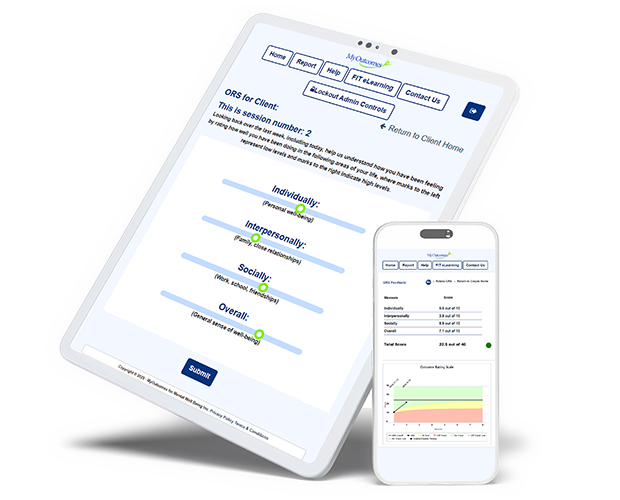
For two decades, the Outcome Rating Scale (ORS) has repeatedly been proven to be a reliable and valid therapeutic instrument that can be easily and effectively incorporated into any therapis/counsellor-client session (Miller, Duncan, Brown, Sparks, & Claud, 2003; Bringhurst, Watson, Miller, & Duncan, 2006; Campbell & Hemsley, 2009). Further evidence has been accumuating that demonstrates the generalizability of the ORS to a variety of clinical populations and settings: couples, addictions, adolescents, groups, and much more (Anker, Duncan, & Sparks, 2009).
With MyOutcomes®, the ORS takes less than a minute to administer, and the results can then be compared to a predicted score derived from calculations based on data from nearly three-quarters-of-a-million other administrations. The brevity of our ORS makes for an extremely feasible tool that can easily be completed by clients at the beginning or end of each therapeutic session. Although feedback does lead to improved outcomes, it has been demonstrated that regular solicitation of feedback is significantly more effective (Reese, Norsworthy, & Rowlans, 2009).
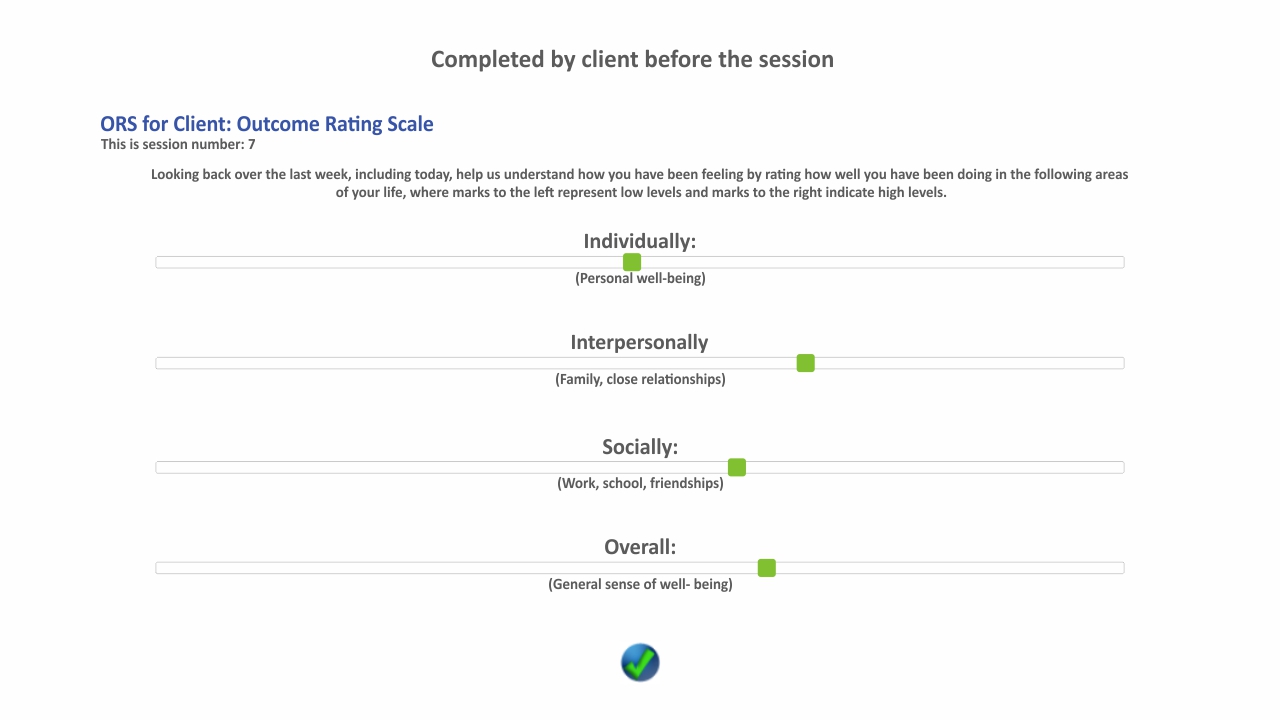
Using four visual scales, the ORS is a brief outcome measure that enables clients to provide feedback on their perceptions of their progress in achieving their therapeutic goals. Specifically, the four scales allow the client to provide a quantifiable measure of how they are functioning on a personal level, in their interpersonal relationships (friends and family), their general social interactions, as well as a more global measure of their overall functioning.
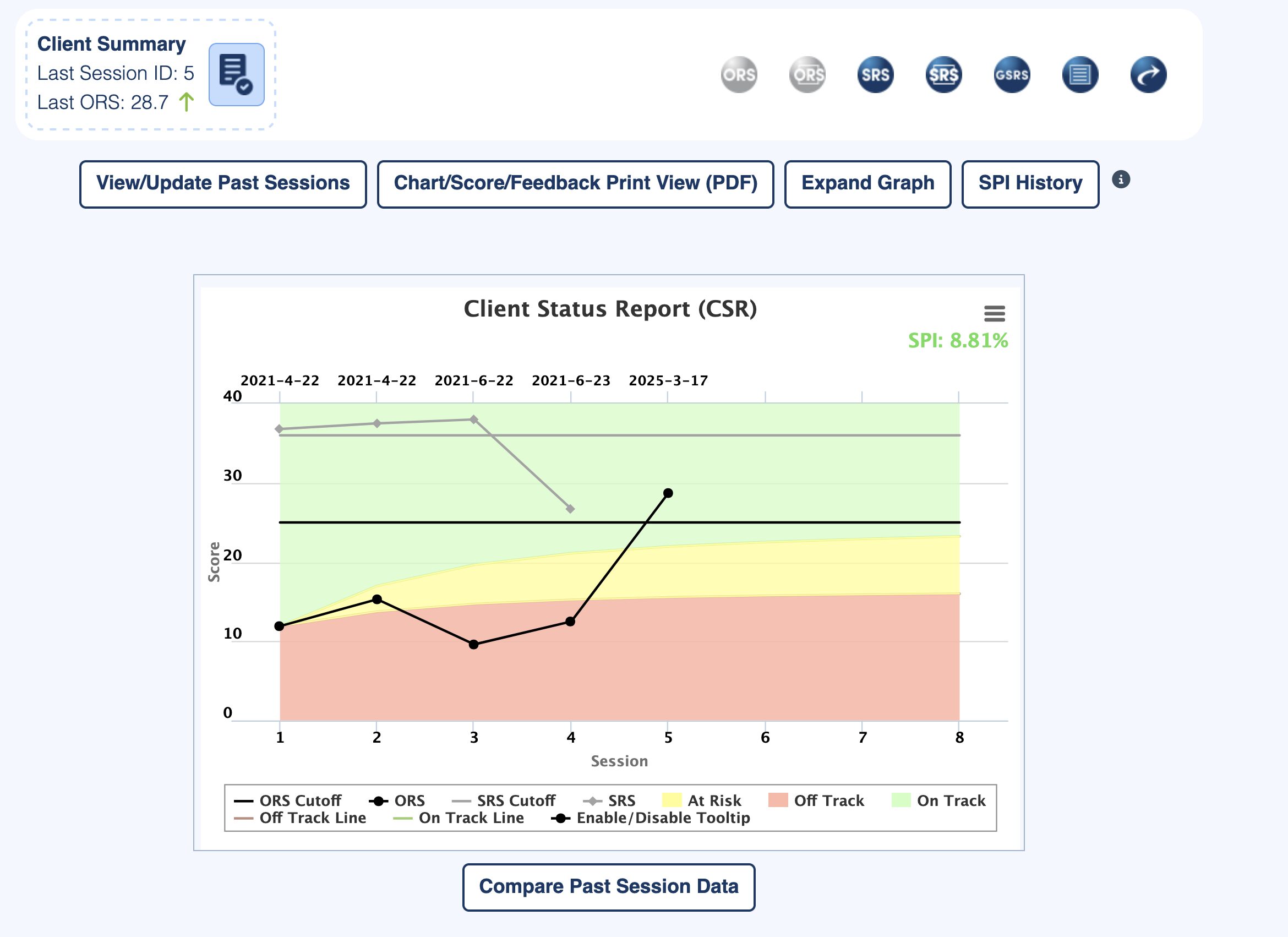
MyOutcomes® automatically plots each session’s ORS on a continuous graph so that the therapist/counsellor can determine if the trajectory of change is on or off track.
Duncan, B., Miller, S., Sparks, J., Claud, D., Reynolds, L., Brown, J., & Johnson, L. (2003). The Session Rating Scale: preliminary psychometric properties of a “working” alliance measurement. Journal of Brief Therapy, 3(1), 3-12.
Anker, M. G., Duncan, B. L., & Sparks, J. A. (2009). Using client feedback to improve couple therapy outcomes: A randomized clinical trial in a naturalistic setting. Journal of Consulting & Clinical Psychology, 77, 693–704. doi:10.1037/a0016062.
APA Task Force on Evidence-Based Practice (2006). Evidence-based practice in psychology. American Psychologist, 61, 4, 271-285.
Bringhurst, D.L., Watson, C.W., Miller, S.D. & Duncan, B.L. (2006). The reliability and validity of the Outcome Rating Scale: A replication study of a brief clinical measure. Journal of Brief Therapy, 5, 1, 23-30.
Campbell, A & Hemsley, S. (2009). Outcome Rating Scale and Session Rating Scale in psychological practice: Clinical utility of ultra-brief measures. Clinical Psychologist, 13, 1, 1-9.
Miller, S.D., Duncan, B.L., Brown, J., Sparks, J.A. & Claud, D.A. (2003). The Outcome Rating Scale: A preliminary study of the reliability, validity, and feasibility of a brief visual analog measure. Journal of Brief Therapy, 2, 2, 91-100.
Norcross, J.C. & Wampold, B.E. (2011). Evidence-based therapy relationships: Research conclusions and clinical practices. Psychotherapy, 1, 98-102. doi: 10.1037/a0022161.
Reese, R., Norsworthy, L., & Rowlands, S. (2009). Does a Continuous Feedback Model Improve Psychotherapy Outcome?Psychotherapy: Theory, Research, and Practice, 46, 418-431.
The Outcome Rating Scale (ORS) is an ultra-brief, four-item visual analog measure designed to track a client’s therapeutic progress and well-being session by session. Developed as a practical alternative to lengthy assessment batteries, the ORS allows clinicians to monitor the effectiveness of treatment in real-time, ensuring that therapy remains on track and responsive to the client’s needs.
- The Focus: It evaluates four key areas of life functioning: Individual (symptom distress), Interpersonal (relationships), Social (work/school), and Overall well-being.
- The Timing: It is typically administered at the very start of every session to establish a “current state” before the therapeutic work begins.
The ORS is scored by measuring the client’s mark on four 10cm lines (Visual Analog Scales), where each line is scored from 0 to 10, resulting in a total possible score of 40. Higher scores represent better functioning and lower distress, while lower scores indicate a greater need for clinical intervention.
- Digital Advantage: While paper versions require a ruler, digital platforms like MyOutcomes automate this scoring instantly, providing a real-time graph of the client’s trajectory.
- Total Score: The sum of the four items provides a global snapshot of the client’s current quality of life.
For the adult Outcome Rating Scale, the standard clinical cutoff score is 25; for adolescents (ages 13–17), the clinical cutoff is 28. These numbers help clinicians distinguish between scores typical of a “clinical population” seeking treatment and those typical of a “non-clinical” or general population.
- Adults (18+): Cutoff = 25
- Adolescents (13–17): Cutoff = 28
- Children (under 12): Typically use the CORS, with cutoffs often set between 28 and 32 depending on the reporting source (child vs. caregiver).
ORS interpretation focuses on “Reliable Clinical Change,” which occurs when a client’s score increases by 5 points or more and crosses the clinical cutoff. Rather than looking at a single score in isolation, therapists look for patterns: rising scores indicate improvement, flat scores suggest a plateau, and falling scores may signal a clinical “deterioration” or a new external stressor.
- Critical Alert: If a client’s score remains flat or drops over several sessions, it serves as an “early warning signal” to adjust the treatment plan or address the therapeutic alliance.
Yes, the ORS is a validated, evidence-based instrument with numerous peer-reviewed studies supporting its reliability and concurrent validity against longer “gold-standard” measures like the OQ-45. Its primary strength lies in its “clinical feasibility”—because it takes less than one minute to complete, clinicians are significantly more likely to use it consistently compared to longer, more burdensome tools.
The Child Outcome Rating Scale (CORS) is a developmentally adapted version of the ORS designed for children aged 6 to 12. It uses simplified language and visual cues to help younger clients (and their caregivers) report on well-being and functioning.
- Family Context: The CORS is often completed by both the child and the caregiver, providing the therapist with two different perspectives on the child’s progress.
- Transitioning: Once a client reaches age 13, they typically transition to the standard ORS.
While the ORS is effective for tracking outcomes, it is most powerful when paired with the Session Rating Scale (SRS) to provide a complete picture of both progress (Outcome) and the therapeutic relationship (Alliance). In the Feedback-Informed Treatment (FIT) framework, the ORS tells you if the client is getting better, while the SRS helps explain why or why not by measuring the quality of the session.
The ORS is a “global” measure of well-being, whereas the PHQ-9 and GAD-7 are “symptom-specific” measures for depression and anxiety. Many high-performing clinics use the ORS as their primary session-by-session tool and supplement it with the PHQ-9 or GAD-7 at monthly intervals to provide deeper diagnostic detail for insurance reporting or specialized treatment tracks.
Can’t find what you’re looking for?
Connect With Us
Need more information or want to speak with one of our customer care experts?